
80 questions answered · 200 marks · Eastern Cape DoE
Consumer Studies Grade 12 NSC September 2025 (Eastern Cape) Questions and Answers
Every question from the NSC Preparatory Examination (Eastern Cape DoE, September 2025), with a full answer written from the Grade 12 Consumer Studies textbook and the official marking approach. Open a question to see its answer, or use Hide answers to practise first.
Instructions
The paper has six compulsory questions: Section A has short questions on all topics, and Section B covers the consumer, food and nutrition, clothing, housing and entrepreneurship.
Section A
31 questionsC: Stokvel
In a stokvel members pay into a common pool and take turns to receive the money.
C: to calculate the official rate of inflation.
The CPI tracks price changes of a basket of goods and is used to work out the official inflation rate.
D: Repo rate
The repo rate is the rate the Reserve Bank charges commercial banks.
B: Consumer Protection Act
The Consumer Protection Act gives a five business day cooling-off period for direct marketing.
B: discolouration and rancidity.
Antioxidants stop fats from going rancid and stop cut fruit and vegetables from turning brown.
C: Chicken and lentil stew served with brown rice.
Lentils and brown rice are high in fibre and the meal has no coconut milk, cream or frying, so it is low in saturated fat.
B: Tuberculosis
Tuberculosis spreads through droplets in the air, while the others spread through contaminated food and water.
C: It is available in most stores
When a style becomes available in most stores it is moving up the fashion cycle towards its peak.

B: Trousers B
Trousers B have a design feature, such as a wide cuff or horizontal detail at the ankle, that cuts the leg line and makes the legs look shorter.

D: Retrospective fashion
Retrospective fashion brings back styles from an earlier time, which is what the picture shows.
B: 3, 5 and 6
Basic colours, a positive company image and neat, ironed clothes suit an interview. Standing out or revealing clothes do not.
B: 2, 1, 4, 3
The offer to purchase comes first, then the deed of sale, then the transfer deed, and the title deed is issued last.
C: rates and taxes.
The levy covers the body corporate's costs, including rates and taxes on the common property.
D: A dishwasher with a half load option saves water.
Only the half load option is about saving a resource (water), so it lowers the environmental impact.
A: Collateral
Collateral is an asset pledged to the lender as security for repayment.
D: Target market
The target market is the group the marketing is aimed at.
B: Use the feedback to improve your service.
Using customer feedback to improve service shows that the business values its customers.
A: speed up the production process.
Good planning avoids delays and so speeds up production.
D: Charged on electricity generated by using coal
This describes environmental levy.
F: Payable on property after a citizen's death
This describes estate duty.
B: Includes a levy payable to the Road Accident Fund
This describes fuel tax.
C: Added to the selling price of specified goods and services
This describes value-added tax.
The five responsibilities of tenants are:
- B: a tenant must tell the landlord in writing when planning to move out.
- C: a tenant must keep the property clean.
- E: a tenant must repair any damage that the tenant caused.
- G: a tenant must pay the rent every month.
- H: a tenant must pay the monthly service charges.
The four statements that show the purpose of stock control are:
- C: it makes sure that the right materials are bought.
- D: it keeps production running without running out of materials.
- E: it prevents materials from being wasted.
- H: it prevents unnecessary spending.
Unfair business practice
Businesses treat consumers in an unreasonable or unfair way.
Pyramid scheme
Money comes only from recruiting new members, not from selling a real product.
Product specification
It sets out exactly what the product or service must be like.
Exemption clause
It frees one party from responsibility for certain losses or damage.
Contract
An offer that is accepted creates a legally binding agreement.
Section B
49 questionsTwo forms of renewable energy are:
- Solar (sun) energy.
- Wind energy.
Phishing can be explained in these three points:
- It is a fake e-mail, message or call that pretends to come from a bank or other trusted institution.
- It asks the person to click a link or give personal details, and the link leads to a fake website that looks real.
- The criminals use the personal and financial information that is captured to steal money from the person's account.
SARS introduced a duty of 45% plus VAT on all clothing from 1 July 2024 to address the imbalance between platforms like Temu and local retailers. Local e-commerce players claimed that Shein and Temu exploited tax loopholes and undercut South African retailers.
Import duty.
It is the duty charged on clothing brought into the country.
Shein and Temu clothing is not classified as parallel goods for two reasons:
- The manufacturer has given permission for the goods to be sold, so they are not sold without the owner's consent.
- Consumers order directly from the manufacturer or seller, not from a third party who imported the goods without authority.
The four reasons for the higher tax are:
- The extra tax makes the goods more expensive, which discourages consumers from ordering from these platforms.
- Consumers are encouraged to support local businesses, which helps to prevent job losses.
- Local retailers get a fairer chance to compete, because they struggle to match the very low prices of Shein and Temu.
- The extra tax income can be used for social and economic programmes and buying local products stimulates the South African economy.
The four effects of a VAT increase are:
- Food prices will rise, because VAT is added to the selling price of most goods and services.
- Consumers will have to pay more for the same items, so their purchasing power falls.
- Their disposable income is reduced, as more of the money they earn goes to essential items.
- Living costs rise and spending drops, especially on non-essential items, and it becomes harder to keep up the current standard of living.
Three ways to use water more efficiently in the garden are:
- Plant indigenous, water-wise plants and group plants with similar water needs together.
- Spread mulch on the soil to hold the moisture.
- Water early in the morning or late in the afternoon and not on windy days, so that less water evaporates.
Three ways to use water more efficiently for personal care are:
- Take a short shower rather than a bath, and do not fill the bath completely.
- Close the tap while brushing your teeth, shaving or soaping yourself.
- Fit tap aerators and low-flow shower heads, and collect shower water in a bucket to flush the toilet or water pot plants.
Herbalife sells nutrition, weight management and wellness products through independent distributors. Distributors buy products at a discount and sell them for a profit. They also recruit others to become distributors and earn commission on their recruits' sales.
Two reasons why this is a multilevel marketing scheme are:
- Distributors must recruit other people, who in turn recruit more people, and earn commission on their recruits' sales.
- It involves a real product, and income comes from selling these products, which makes it a legal scheme.
The four advantages of a two-year guarantee are:
- It is a written promise that the product or service will meet certain quality standards for two years.
- The manufacturer promises to repair or replace the item if a fault appears within the two years.
- It protects the consumer against loss, because faulty goods do not have to be paid for twice.
- The consumer can usually choose whether the item is repaired, replaced or refunded.
The difference between simple and compound interest can be explained in four points:
- Simple interest is calculated only on the original amount (principal) of the loan or investment.
- No interest is earned on interest in simple interest, and it is mainly used for short-term loans.
- Compound interest is calculated on the principal plus the interest that has already been added.
- With compound interest the consumer earns or pays interest on interest, and it can be added monthly, quarterly, half-yearly or yearly.
Six things that municipalities can do to increase tourism are:
- Budget for advertising campaigns and promote the area to other provinces and countries.
- Make sure that sewerage works and that refuse is removed regularly.
- Keep public lights working and public areas, parks and beaches clean and well maintained.
- Work with the police to fight crime so that tourists feel safe.
- Organise and support local events such as sport tournaments and music festivals.
- Build partnerships between the public and private sectors and involve the community in tourism planning.
Food additives are natural or chemical substances added to food during processing or production to preserve it or to improve its flavour, texture or appearance.
Food security can be defined in three points:
- It means being able to get enough food every day.
- The food must be adequate and safe.
- It must allow for an active and healthy lifestyle.
Five pieces of information on a food label are:
- The list of ingredients.
- Nutritional information and claims.
- The sell-by, use-by or best-before date.
- Storage and preparation instructions.
- Allergens and additives, or endorsements such as the Heart Foundation tick.
Green Harvest Market is a supermarket selling certified organic fruit, vegetables, grains and dairy from sustainable farms, free from synthetic pesticides or additives. The prices are much higher than those of mass-produced products.
Six reasons for choosing organic products are:
- They are healthier and taste better.
- They contain no chemical pesticides, so pollution is reduced.
- They contain no chemical preservatives or artificial additives.
- Animals are not given growth hormones or unnecessary antibiotics, and are treated more humanely.
- Organic farming improves soil quality and protects the water supply from poisonous run-off.
- Organic farms need more workers, so more jobs are created, and resources are used responsibly.
Three dietary guidelines to prevent iron-deficiency anaemia are:
- Eat iron-rich foods such as liver and red meat.
- Eat foods rich in vitamin C together with iron-rich foods.
- Avoid drinking coffee or tea with meals.
The three reasons for the guidelines are:
- Iron from animal sources (haem iron) is absorbed more easily than iron from plant sources.
- Vitamin C helps the body to absorb iron.
- The tannin in coffee and tea reduces iron absorption.
Gastroenteritis can be transmitted in four ways:
- By eating or drinking contaminated food or water.
- By sharing utensils with an infected person.
- Through unwashed hands.
- Through contact with an infected person, or when an infected person prepares food.
Cholesterol leads to coronary heart disease in four steps:
- When blood cholesterol is too high, it builds up as plaque in the coronary arteries.
- The plaque makes the arteries narrow, thicken and harden, which is called atherosclerosis.
- This blocks the flow of blood and oxygen to the heart.
- Without enough oxygen the heart muscle can fail, causing a heart attack.
Thabo is a 36-year-old bachelor who seldom cooks and regularly eats a lot of junk food. He always sprinkles extra salt on his food.
Blood pressure can be explained in two points:
- It is the pressure of the blood against the artery walls as it circulates through the body.
- It is measured at a high point (systolic) and a low point (diastolic).
Two causes of hypertension are:
- An unhealthy diet with too much salt, together with being overweight or obese.
- A stressful lifestyle, lack of physical activity, smoking or too much alcohol.
Thabo could have reduced his salt intake in five ways:
- Flavour his food with herbs and spices instead of salt.
- Stop sprinkling extra salt and limit the salt used when cooking, to no more than about 5 g (one teaspoon) a day.
- Eat less junk and processed food, such as pizza, bacon and smoked meat, because they contain hidden salt.
- Avoid salted snacks such as chips, biltong and salted nuts, and avoid soup powders, stock and gravies.
- Read labels and avoid products with salt, sodium or MSG in the ingredients, choosing those low in salt.
Fashion is a style of clothing that is accepted and worn by a specific group of people, or by most people, at a given time and place.


Three advantages of classic styles are:
- They suit most figures, so almost everyone looks good in them.
- They are timeless and stay acceptable for many seasons.
- They are simple, tasteful and usually of good quality.
Tina saw a dress on television for R799,00. A few months later it cost R599,00 at Truworths. The last time she saw it, it was marked down 50% to R299,00.
At R599,00 the dress is at the peak stage, which is shown by two points:
- The style is at its height of popularity and many people wear it.
- It is mass produced in growing numbers and widely advertised, which stimulates sales.
At R299,00 the dress is at the obsolescence stage, which is shown by two points:
- The style is out of fashion and fewer consumers buy it, as a new trend is already taking over.
- The shop marks down the stock significantly to clear it.
Economic factors contribute to fashion changes in four ways:
- Recessions, inflation, wealth and poverty can speed up or slow down fashion changes.
- Fashion flourishes where consumers have plenty of money to spend on clothes.
- When incomes are high and credit is easy to get, people buy more and fashion changes faster.
- In poorer communities there is hardly any change in fashion.
Technological factors contribute to fashion changes in three ways:
- New synthetic fibres, finishes and production methods keep bringing change to the industry.
- Better sewing and knitting machines speed up manufacturing, so more clothes are made and costs can fall.
- Mass media and the internet spread fashion news quickly, and improved distribution brings new garments to stores within days.
Second-hand shopping helps the environment in four ways:
- Unwanted garments are reused instead of being thrown away.
- Less waste goes to landfill sites, so less landfill space is used.
- Fewer new clothes need to be manufactured, which reduces pollution and the carbon footprint.
- Less water and electricity are used in manufacturing, which is better for the natural environment.
The NHBRC protects and assists homeowners by making sure that houses are built to adequate standards and that building contractors behave responsibly.

The three families use these housing options:
- Family A is renting.
- Family B is buying.
- Family C is building.
The difference in ownership can be explained in four points:
- Family C has full title ownership, so it is the legal owner of both the land and the structure.
- The owner under full title is responsible for the rates and taxes, services and maintenance of the whole property.
- Family B lives in a sectional title scheme, where each unit or section of the building is owned individually.
- Family B also owns a share of the common property, such as the grounds and passages, together with the other owners.
Five possible consequences of not meeting financial responsibilities are:
- If bond repayments are not made, the bank may repossess the property.
- Unpaid rates and taxes attract interest that keeps building up.
- Unpaid water and electricity accounts can lead to services being cut off.
- If insurance is not paid, there may be no payout after damage such as a fire or flood.
- Their credit record will suffer, and a neglected property loses its value.
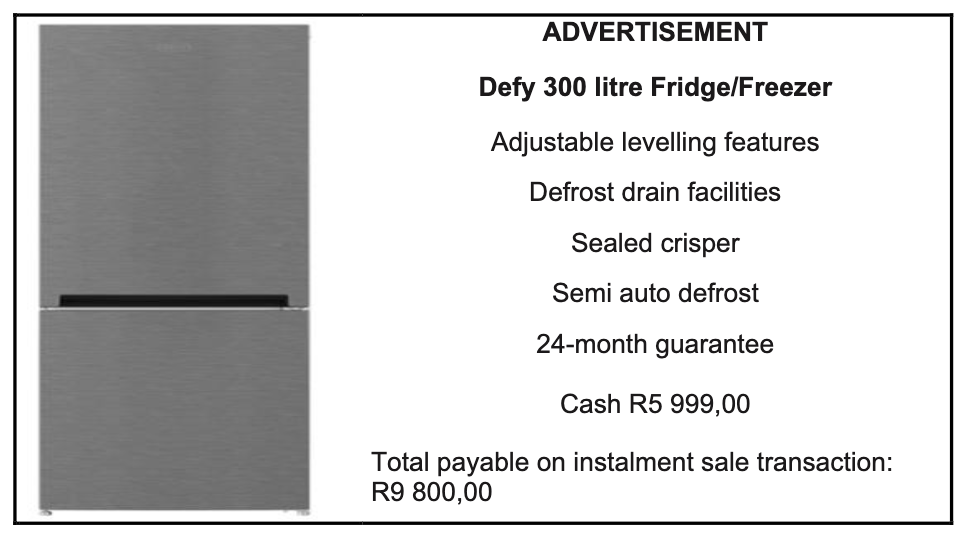
Three factors to consider when choosing a fridge/freezer are:
- The size of the family and the space available for it.
- The budget, running costs and energy efficiency.
- The length and comprehensiveness of the guarantee, and the reliability of the dealer.
An instalment sale and its higher cost can be explained in three points:
- The buyer takes the goods home after paying a deposit, but does not become the owner until all instalments are paid.
- The balance is paid off in monthly instalments over a period such as 12, 24 or 36 months, and the seller may repossess the goods if the terms are broken.
- It costs more because finance charges (interest) are added to the cash price to pay the seller for selling on credit.
A work plan is a document that states which tasks must be done, and in what order, to achieve your goals and meet the delivery date.

Four requirements of high-quality packaging for pizzas are:
- It must catch the eye of consumers and stand out from similar brands.
- It must be the right size and shape to protect the pizza's appearance.
- It must be strong enough for transport and easy to open, close and handle.
- It must protect the pizza from dust, moisture and contamination and keep it warm.
Four pricing strategies the business can use are:
- Premium pricing.
- Value-for-money pricing.
- Undercut pricing.
- Competition-based pricing.
Four advantages of using local ingredients are:
- Local ingredients may be cheaper, as there are no import costs.
- It supports the South African economy by keeping money in the country.
- The ingredients are fresh and of better quality, and are readily available so production is not interrupted.
- Less fuel is used for transport, which makes delivery cheaper and reduces carbon dioxide emissions.
Four benefits of keeping to product specifications are:
- Products are always made to the same quality and standard.
- The target market knows what to expect and gets what they expect.
- Workers know exactly what to produce and stick to it.
- Appearance, size, weight and colour stay consistent, so there are fewer failures and less lost profit.
The three factors they had to consider are:
- Availability of human skills: Craig had learned how to make pizza, so the skill needed for the product was available.
- Availability of raw materials: they could order fresh ingredients from local farms.
- Consumer appeal: they offered a variety of flavours and handed out samples to test whether students liked the product.
Word-of-mouth advertising markets the business in two ways:
- They gave out samples and told people about their business, so people began to talk about it.
- The quality pizzas appealed to customers, who then told others about them.
\[ \text{Profit} = \text{selling price} - \text{production cost} \]
\[ = \text{R}56{,}00 - \text{R}36{,}00 \]
\( = \text{R}20{,}00 \)
\[ \text{Profit} = \text{total income} \times \frac{\text{profit margin}}{100} \]
\[ = \text{R}60\,000 \times \frac{60}{100} \]
\( = \text{R}36\,000{,}00 \)
Eight reasons why the business is likely to be profitable over time are:
- Craig was trained in pizza making, so the business has the necessary skill.
- They offer a variety of flavours and abundant toppings.
- They give great customer service.
- They are committed to giving customers amazing pizzas.
- They spent many hours testing their recipes and offered samples.
- The product is innovative and creative and meets customers' needs.
- They deliver fresh, hot pizza and use fresh local ingredients from nearby farms.
- The business became so popular that the successful Steers Group acquired it.