Technical Sciences Grade 12 NSC September 2025 P1 (Eastern Cape) Questions and Answers
Every question from the NSC Preparatory Examination (Eastern Cape DoE, September 2025), with a full answer written from the Grade 12 Technical Sciences textbook and the official marking approach. Open a question to see its answer, or use Hide answers to practise first.
Ten compulsory questions: multiple choice (20 marks) followed by structured physics questions on forces, momentum, energy, elasticity, light, electromagnetic radiation, capacitors, circuits and induction.
Question 1: Multiple choice
10 questions
1.1
Newton's First Law of Motion implies that an object will continue moving at constant velocity as long as the ... 2 marks
A sum of all the forces acting on the object is greater than zero but less than one.B net force experienced by the object is less than zero.C net force experienced by the object is greater than zero.D sum of all forces acting on the object is zero.
Answer
D: sum of all forces acting on the object is zero.
An object keeps a constant velocity only while the net force on it is zero.
Full answer and marking tips
1.2
A crane lifts a \(50\ \text{kg}\) load with a rope at a constant velocity. What is the tension (force) in the rope? Ignore air friction. 2 marks
A \(500\ \text{N}\), upwardsB \(500\ \text{N}\), downwardsC \(490\ \text{N}\), upwardsD \(490\ \text{N}\), downwards
Answer
C: \(490\ \text{N}\), upwards
Constant velocity means the net force is zero, so the tension equals the weight: \(F_T = mg = 50 \times 9{,}8 = 490\ \text{N}\), acting upwards.
Full answer and marking tips
1.3
The law of conservation of momentum implies that ... after the collision. 2 marks
A the kinetic energy before the collision is equal to the kinetic energyB in an isolated system the kinetic energy before collision is equal to the kinetic energyC in an isolated system the total linear momentum before the collision is equal to the total linear momentumD both objects will be at rest
Answer
C: in an isolated system the total linear momentum before the collision is equal to the total linear momentum
In an isolated system the total momentum before a collision equals the total momentum after it.
Full answer and marking tips
1.4
A ball with mass \(m\) strikes a wall with speed \(v\). Assume that the collision is elastic. If the ball bounces back with the same speed \(v\), the magnitude of the change in momentum will be ... 2 marks
A \(2mv\) in the opposite direction.B \(mv\) in the opposite direction.C \(2mv\) in the original direction.D \(mv\) in the original direction.
Answer
A: \(2mv\) in the opposite direction.
\(\Delta p = m(-v) - mv = -2mv\), so the change is \(2mv\) in the direction opposite to the original motion.
Full answer and marking tips
Graphs for QUESTION 1.5
Graph A
Graph B
Graph C
Graph D
1.5
A ball is dropped and falls vertically downwards (ignore air resistance). Which ONE of the following graphs is CORRECT for the mechanical energy (\(ME\)) of the ball versus time (\(t\))? 2 marks
A Graph AB Graph BC Graph CD Graph D
Answer
C: Graph C
With no air resistance, mechanical energy is conserved, so the graph of \(ME\) against \(t\) is a horizontal straight line (graph C).
Full answer and marking tips
1.6
Which ONE of the following explains best why walls of dams are built THICKER at the bottom than at the top? 2 marks
A Liquid pressure decreases with an increase in depth.B Liquid pressure increases with an increase in depth.C Density of a liquid decreases with an increase in depth.D Density of a liquid increases with an increase in depth.
Answer
B: Liquid pressure increases with an increase in depth.
Pressure in a liquid is given by \(P = \rho g h\), so it grows with depth and the base of the wall must be stronger.
Full answer and marking tips
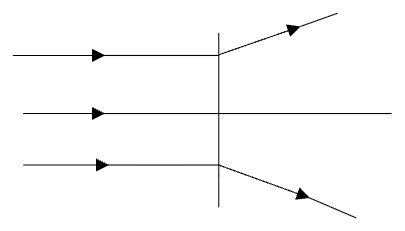
Diagrams for QUESTION 1.7
Diagram A
Diagram B
Diagram C
Diagram D
1.7
Parallel rays of light strike a concave lens. Which ONE of the diagrams below shows what happens to the rays when they strike the lens? 2 marks
A Diagram AB Diagram BC Diagram CD Diagram D
Answer
C: Diagram C
A concave lens is a diverging lens: parallel rays spread out after passing through it (diagram C).
Full answer and marking tips
1.8
A light ray passes from glass to air. The angle of incidence is \(40^\circ\) and the critical angle of the glass-air surface is \(42^\circ\). Which ONE of the following is CORRECT about the path of the light ray? The light ray will undergo ... 2 marks
A refraction towards the normal.B refraction away from the normal.C total internal reflection.D neither reflection nor refraction.
Answer
B: refraction away from the normal.
The angle of incidence is smaller than the critical angle, so there is no total internal reflection. Light moving from a denser to a less dense medium bends away from the normal.
Full answer and marking tips
1.9
The unit of the electromotive force (emf) is ... 2 marks
A Newton.B Watt.C Joule.D Volt.
Answer
D: Volt.
Emf is measured in volts, the same unit as potential difference.
Full answer and marking tips
1.10
An electrical machine that uses a commutator (split-ring) and converts mechanical energy to electrical energy is called a ... 2 marks
A DC generator.B AC motor.C AC generator.D DC motor.
Answer
A: DC generator.
A split-ring commutator gives direct current, and a machine that turns mechanical energy into electrical energy is a generator.
Full answer and marking tips
Question 2: Forces
7 questions
Case study: the toolbox
A tool box of mass \(200\ \text{kg}\) rests on a horizontal rough surface. Ntombi pulls the tool box with a force of \(150\ \text{N}\) at an angle of \(60^\circ\) to the horizontal using a rope, as shown in the diagram. The box is not moving as she is pulling it.
2.1
Draw a free-body diagram to show ALL the forces acting on the toolbox. 4 marks
Answer
Draw the toolbox as a dot or box with four labelled arrows, all starting at the box:
Weight \(F_g\) (or \(mg\)), pointing straight down. Normal force \(F_N\), pointing straight up. Ntombi's applied force \(F_{Ntombi} = 150\) N, pointing up and to the right at \(60^\circ\) to the horizontal (or its components \(F_x\) horizontally and \(F_y\) vertically). Frictional force \(f\), pointing horizontally to the left, opposite to the horizontal pull. Arrows must touch the body, be solid lines and carry labels. No extra forces.
Full answer and marking tips
2.2
Name and define the law in Science that can be used to explain why the toolbox is not moving. 3 marks
Answer
Newton's First Law of Motion.
An object stays at rest or keeps moving at constant velocity unless a non-zero net (resultant) force acts on it.
Full answer and marking tips
2.3
Use the law in QUESTION 2.2 to explain why the toolbox is not moving. 2 marks
Answer
The horizontal component of Ntombi's pull is balanced by the static friction, so the net force on the toolbox is zero. With no net force, it stays at rest.
Full answer and marking tips
Case study: the toolbox (continued)
After some time, Ntombi asks for help from Mncedisi, who pushes the tool box from behind with a force of \(80\ \text{N}\). The tool box starts moving in the direction in which Ntombi is pulling.
2.4.1
Define tension force and give an example of such a force in the diagram above. 3 marks
Answer
Tension is a pulling force that acts along a string or rope.
Example: the \(150\ \text{N}\) force Ntombi applies through the rope, \(F_{Ntombi}\).
Full answer and marking tips
2.4.2
How will the frictional force on the tool box be affected by Ntombi's applied force? Write only INCREASES, DECREASES or REMAINS CONSTANT. 2 marks
Answer
DECREASES.
The vertical component of her pull reduces the normal force, and friction depends on the normal force.
Full answer and marking tips
2.4.3
Draw a free-body diagram to show ALL the horizontal forces acting on the tool box and its contents. 3 marks
Answer
Draw the box with three horizontal arrows only:
The horizontal component of Ntombi's pull, \(F_x = 150\cos 60^\circ\), pointing in the direction of motion (right). Mncedisi's push, \(F_{Mncedisi} = 80\) N, also pointing right. Kinetic friction \(f_k\), pointing left, opposite to the motion. No vertical forces are shown.
Full answer and marking tips
2.4.4
If the net force acting on the tool box and its contents is \(105\ \text{N}\), calculate the coefficient of kinetic friction between the surface and the tool box. 6 marks
Answer
Take the direction of motion as positive.
\[ F_{net} = F_{Ntombi}\cos 60^\circ + F_{Mncedisi} - f_k \]\[ 105 = 150\cos 60^\circ + 80 - f_k \]\[ f_k = 155 - 105 = 50\ \text{N} \]
The normal force is reduced by the vertical part of the pull:
\[ N = mg - F_{Ntombi}\sin 60^\circ = (200)(9{,}8) - 150\sin 60^\circ = 1830{,}10\ \text{N} \]\[ f_k = \mu_k N \Rightarrow \mu_k = \frac{50}{1830{,}10} \]
\( \mu_k = 0{,}03 \) (0,027)
Full answer and marking tips
Question 3: Momentum and impulse
9 questions
Case study: taxi and car collision
A minibus taxi of mass \(1\,500\ \text{kg}\) moving towards the east travels at \(120\ \text{km}\cdot\text{h}^{-1}\). It collides head-on with a car of mass \(1\,100\ \text{kg}\) travelling in the opposite direction at \(16{,}67\ \text{m}\cdot\text{s}^{-1}\). After the collision the minibus moves east at \(20{,}3\ \text{m}\cdot\text{s}^{-1}\) and the car moves backwards at \(5{,}32\ \text{m}\cdot\text{s}^{-1}\).
3.1
Define momentum. 2 marks
Answer
Momentum is the product of an object's mass and its velocity.
Full answer and marking tips
3.2
What is the velocity, in \(\text{m}\cdot\text{s}^{-1}\), of the minibus before the collision takes place? 2 marks
Answer
\[ v_i = 120 \times \frac{1000}{3600} \]
\( v_i = 33{,}33\ \text{m}\cdot\text{s}^{-1} \), east
Full answer and marking tips
3.3
Calculate the initial momentum of the car. 3 marks
Answer
\[ p = m v_i = (1100)(16{,}67) \]
\( p = 18\,337\ \text{kg}\cdot\text{m}\cdot\text{s}^{-1} \), west
Full answer and marking tips
3.4.1
Explain what is meant by isolated system. 2 marks
Answer
An isolated system is one on which the net external force is zero.
Full answer and marking tips
3.4.2
Use a calculation to determine whether the collision was elastic or inelastic. 5 marks
Answer
Compare the total kinetic energy before and after the collision.
\[ \sum E_{ki} = \tfrac{1}{2}(1500)(33{,}33)^2 + \tfrac{1}{2}(1100)(16{,}67)^2 \approx 986\,006\ \text{J} \]\[ \sum E_{kf} = \tfrac{1}{2}(1500)(20{,}3)^2 + \tfrac{1}{2}(1100)(5{,}32)^2 \approx 324\,634\ \text{J} \]
\( \sum E_{ki} \neq \sum E_{kf} \), so kinetic energy is not conserved.
The collision is inelastic.
Full answer and marking tips
Case study: motorbike crash
A motorbike of mass \(1\,150\ \text{kg}\) crashes into a tree with a velocity of \(15\ \text{m}\cdot\text{s}^{-1}\), as shown in the diagram. The motorbike experiences a constant net force of \(57\,500\ \text{N}\) before it comes to rest.
3.5.1
What is the relationship between the net force experienced by the motorbike and the contact time during the crash? 2 marks
Answer
They are inversely proportional: the longer the contact time, the smaller the net force, since \( F_{net} = \frac{\Delta p}{\Delta t} \).
Full answer and marking tips
3.5.2
How does the impulse experienced by the motorbike compare to its change in momentum? Write only SMALLER THAN, GREATER THAN or EQUAL TO. 1 mark
Answer
Full answer and marking tips
3.5.3
Modern vehicles are equipped with airbags. Explain, using impulse, how this would reduce the extent of the injuries to occupants. 3 marks
Answer
Three points explain how an airbag reduces injuries:
The impulse (change in momentum) of the occupant stays the same. The airbag increases the contact time during the crash. A longer contact time gives a smaller force on the occupant, so the injuries are less severe. Full answer and marking tips
3.5.4
Calculate the contact time during the crash of the motorbike. 4 marks
Answer
Take the direction towards the tree as negative for the force (it opposes the motion).
\[ F_{net}\Delta t = \Delta p = m(v_f - v_i) \]\[ -57\,500\,\Delta t = 1150(0 - 15) \]
\( \Delta t = 0{,}30\ \text{s} \)
Full answer and marking tips
Question 4: Work, energy and power
7 questions
Case study: falling hammer
A construction worker drops a hammer of mass \(0{,}55\ \text{kg}\) from a height of \(8\ \text{m}\) above the ground. Treat the system as isolated.
4.1.1
State the principle of conservation of mechanical energy in words. 2 marks
Answer
In an isolated system, the total mechanical energy (the sum of gravitational potential energy and kinetic energy) stays constant.
Full answer and marking tips
4.1.2
Calculate the mechanical energy of the hammer at \(8\ \text{m}\) above the ground. 3 marks
Answer
\[ ME = E_p + E_k = mgh + \tfrac{1}{2}mv^2 = (0{,}55)(9{,}8)(8) + 0 \]
\( ME = 43{,}12\ \text{J} \)
Full answer and marking tips
4.1.3
Calculate the magnitude of the velocity of the hammer at a height of \(3{,}5\ \text{m}\) above the ground. 5 marks
Answer
Mechanical energy is conserved:
\[ mgh + \tfrac{1}{2}mv^2 = 43{,}12 \]\[ (0{,}55)(9{,}8)(3{,}5) + \tfrac{1}{2}(0{,}55)v^2 = 43{,}12 \]\[ 18{,}865 + 0{,}275v^2 = 43{,}12 \]
\( v = 9{,}39\ \text{m}\cdot\text{s}^{-1} \)
Full answer and marking tips
4.1.4
Without using calculations, write down the magnitude of the hammer's kinetic energy at which it hits the ground. Give a reason for the answer. 3 marks
Answer
\( 43{,}12\ \text{J} \)
Mechanical energy stays constant, and at the ground the potential energy is zero, so all the mechanical energy is kinetic.
Full answer and marking tips
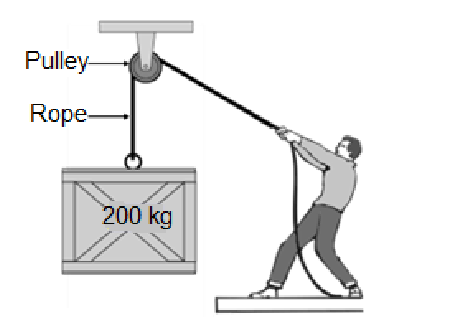
Diagram: man and pulley
The diagram shows a man using a rope on a frictionless pulley to lift a \(200\ \text{kg}\) box at a constant velocity of \(4\ \text{m}\cdot\text{s}^{-1}\).
4.2.1
Calculate the magnitude of the force exerted by the rope on the box. 2 marks
Answer
The box moves at constant velocity, so the rope force equals the weight.
\[ F = F_g = mg = (200)(9{,}8) \]
\( F = 1960\ \text{N} \)
Full answer and marking tips
4.2.2
Calculate the work done by the man to lift the box at a height of \(3\ \text{m}\). 4 marks
Answer
\[ W = F\Delta y\cos\theta = (1960)(3)\cos 0^\circ \]
\( W = 5880\ \text{J} \)
Full answer and marking tips
4.2.3
Calculate the power output, in watt, needed to lift the box at a height of \(3\ \text{m}\). 3 marks
Answer
\[ P_{ave} = Fv_{ave} = (1960)(4) \]
\( P = 7840\ \text{W} \)
Check: \( \Delta t = 3 \div 4 = 0{,}75 \) s and \( P = \frac{5880}{0{,}75} = 7840 \) W.
Full answer and marking tips
Question 5: Elasticity
4 questions
Case study: steel wire
A cylindrical steel wire of length \(1{,}8\ \text{m}\) and diameter \(2{,}0\ \text{mm}\) is connected by an inextensible material to a roof beam. A \(10\ \text{kg}\) block is attached to the bottom end of the wire and this causes the wire to stretch by \(3 \times 10^{-4}\ \text{m}\).
5.1
Define the term deforming force. 2 marks
Answer
A deforming force is a force that changes the shape and/or size of a body.
Full answer and marking tips
5.2
Calculate the stress on the steel wire. 4 marks
Answer
The wire has diameter \(2{,}0\ \text{mm}\), so its radius is \(0{,}001\ \text{m}\).
\[ \sigma = \frac{F}{A} = \frac{mg}{\pi r^2} = \frac{(10)(9{,}8)}{\pi (0{,}001)^2} \]
\( \sigma = 3{,}12 \times 10^{7}\ \text{Pa} \)
Full answer and marking tips
5.3
Calculate the strain on the steel wire. 3 marks
Answer
\[ \varepsilon = \frac{\Delta L}{L} = \frac{3 \times 10^{-4}}{1{,}8} \]
\( \varepsilon = 1{,}67 \times 10^{-4} \) (no unit)
Full answer and marking tips
5.4
Define a perfectly elastic body and give ONE example. 3 marks
Answer
A perfectly elastic body regains its original shape and size when the deforming force is removed.
Example: a steel spring (or steel).
Full answer and marking tips
Question 6: Light and lenses
7 questions
Diagrams for QUESTION 6
DIAGRAM 1
DIAGRAM 2
6.1.1
Name the phenomenon illustrated by DIAGRAM 1. 1 mark
Answer
Full answer and marking tips
6.1.2
Define the phenomenon mentioned in QUESTION 6.1.1. 2 marks
Answer
Refraction is the bending of light when it passes from one medium into another.
Full answer and marking tips
6.2.1
At what position will the image be formed in DIAGRAM 2? 1 mark
Answer
Behind the object , on the same side of the lens as the object (between the lens and F).
Full answer and marking tips
6.2.2
Mention THREE (3) characteristics of the image formed in QUESTION 6.2.1. 3 marks
Answer
The three characteristics of the image are:
It is virtual, so it cannot be projected on a screen. It is upright, with the same orientation as the object. It is magnified, so it is larger than the object. Full answer and marking tips
6.2.3
Name TWO (2) applications of the type of lens in DIAGRAM 2. 2 marks
Answer
Two applications of a convex lens are:
A telescope. Binoculars (a magnifying glass or a camera lens is also correct). Full answer and marking tips
6.3.1
The object is now moved to F. At what position will the image be formed? 1 mark
Answer
At infinity (no image is formed).
Full answer and marking tips
6.3.2
Explain the answer to QUESTION 6.3.1. 2 marks
Answer
The object sits exactly at the focal point, so the rays leave the lens parallel to each other. Parallel rays never meet, so no real image forms.
Full answer and marking tips
Question 7: Electromagnetic radiation
3 questions
7.1.1
Define electromagnetic wave. 2 marks
Answer
An electromagnetic wave is a changing electric field and magnetic field that are perpendicular to each other and to the direction in which the wave travels.
Full answer and marking tips
Data: X-ray photon
An X-ray photon has an energy of \(1{,}989 \times 10^{-17}\ \text{J}\). Use \(h = 6{,}63 \times 10^{-34}\ \text{J}\cdot\text{s}\) and \(c = 3 \times 10^{8}\ \text{m}\cdot\text{s}^{-1}\).
7.1.2
Calculate the wavelength of the X-ray. 4 marks
Answer
\[ E = \frac{hc}{\lambda} \]\[ 1{,}989 \times 10^{-17} = \frac{(6{,}63 \times 10^{-34})(3 \times 10^{8})}{\lambda} \]
\( \lambda = 1{,}0 \times 10^{-8}\ \text{m} \)
Full answer and marking tips
7.1.3
Name TWO (2) uses of X-rays. 2 marks
Answer
Two uses of X-rays are:
Radiography, to see inside the body, for example to check for broken bones. Radiotherapy, to treat cancer (use in airport and other security scanners is also correct). Full answer and marking tips
Question 8: Capacitors
4 questions
Data: parallel-plate capacitor
A capacitor consists of two metal plates \(0{,}02\ \text{m}\) apart, with air as the dielectric. The permittivity of free space is \(\varepsilon_0 = 8{,}85 \times 10^{-12}\ \text{F}\cdot\text{m}^{-1}\).
8.1.1
Define the term capacitance. 2 marks
Answer
Capacitance is the amount of charge a capacitor can store per volt of potential difference.
Full answer and marking tips
8.1.3
Calculate the total surface area of the metal plates if the capacitance of the capacitor is \(100 \times 10^{-6}\ \text{F}\). 3 marks
Answer
\[ C = \frac{\varepsilon_0 A}{d} \Rightarrow A = \frac{Cd}{\varepsilon_0} \]\[ A = \frac{(100 \times 10^{-6})(0{,}02)}{8{,}85 \times 10^{-12}} \]
\( A = 2{,}26 \times 10^{5}\ \text{m}^2 \)
Full answer and marking tips
8.2
Mention how any of the THREE (3) factors affecting capacitance may be changed to increase the capacitance of a capacitor. 3 marks
Answer
Three ways to increase the capacitance of a capacitor are:
Decrease the distance between the plates. Increase the area of the plates. Use a dielectric material with a higher dielectric constant. Full answer and marking tips
Question 9: Electric circuits
4 questions
Circuit diagram for QUESTION 9
Four resistors are connected to a battery with a terminal potential difference of \(12\ \text{V}\), as shown in the diagram.
9.1
State Ohm's Law in words. 2 marks
Answer
The potential difference across a conductor is directly proportional to the current in it, at constant temperature.
Full answer and marking tips
9.2
Calculate the total current in the circuit. 4 marks
Answer
The \(25\ \Omega\) and \(30\ \Omega\) resistors are in series: \(R_s = 25 + 30 = 55\ \Omega\). This is in parallel with the \(80\ \Omega\) resistor:
\[ \frac{1}{R_p} = \frac{1}{55} + \frac{1}{80} \Rightarrow R_p = 32{,}59\ \Omega \]\[ R_T = R_p + 20 = 52{,}59\ \Omega \]\[ I = \frac{V}{R_T} = \frac{12}{52{,}59} \]
\( I = 0{,}23\ \text{A} \)
Full answer and marking tips
9.3
If the current flows for two minutes, calculate the heat produced by the \(20\ \Omega\) resistor. 4 marks
Answer
\[ W = I^2 R \Delta t = (0{,}23)^2 (20)(120) \]
\( W = 126{,}96\ \text{J} \)
Full answer and marking tips
9.4
The average usage of a \(1\,500\ \text{W}\) kettle is \(7{,}5\) minutes per day for a \(30\) day month. Calculate the monthly cost if the municipal tariff is \(\text{R}3{,}20\) per kilowatt hour. 4 marks
Answer
Time used in the month: \( \frac{7{,}5}{60} \times 30 = 3{,}75\ \text{h} \).
\[ E = P t = (1{,}5)(3{,}75) = 5{,}625\ \text{kWh} \]\[ \text{Cost} = 5{,}625 \times 3{,}20 \]
\( \text{Cost} = \text{R}18{,}00 \)
Full answer and marking tips
Question 10: Electromagnetic induction
3 questions
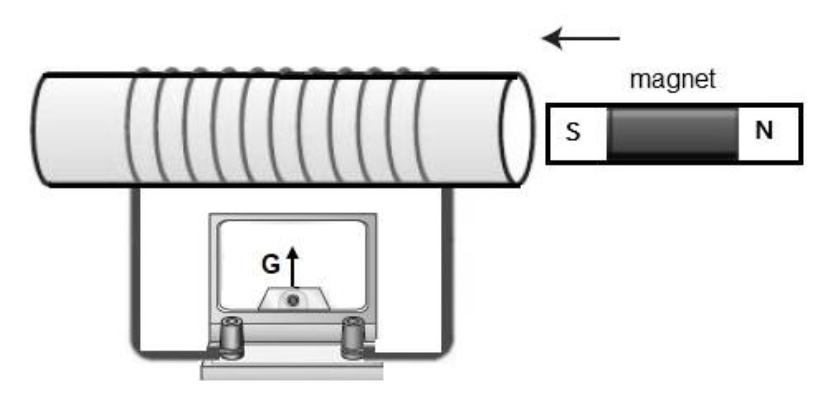
Experiment: bar magnet and coil
An experiment investigates electromagnetic induction using a bar magnet and a cylindrical coil. An electromotive force is generated by moving the bar magnet in and out of the coil.
10.1
Name the law used to describe this phenomenon. 1 mark
Answer
Faraday's law of electromagnetic induction.
Full answer and marking tips
10.2
State the law mentioned in QUESTION 10.1 in words. 2 marks
Answer
When the magnetic flux linked with a coil changes, an emf is induced in the coil. The size of the induced emf is directly proportional to the rate of change of the magnetic flux.
Full answer and marking tips
10.3
Suppose the cylindrical coil has 11 turns and the generated emf is \(20\ \text{V}\) in \(0{,}5\ \text{s}\). Calculate the change in magnetic flux. 3 marks
Answer
\[ \varepsilon = -N\frac{\Delta\phi}{\Delta t} \]\[ 20 = -11\,\frac{\Delta\phi}{0{,}5} \]
\( \Delta\phi = -0{,}91\ \text{Wb} \) (a change of \(0{,}91\ \text{Wb}\) in magnitude)
Full answer and marking tips